
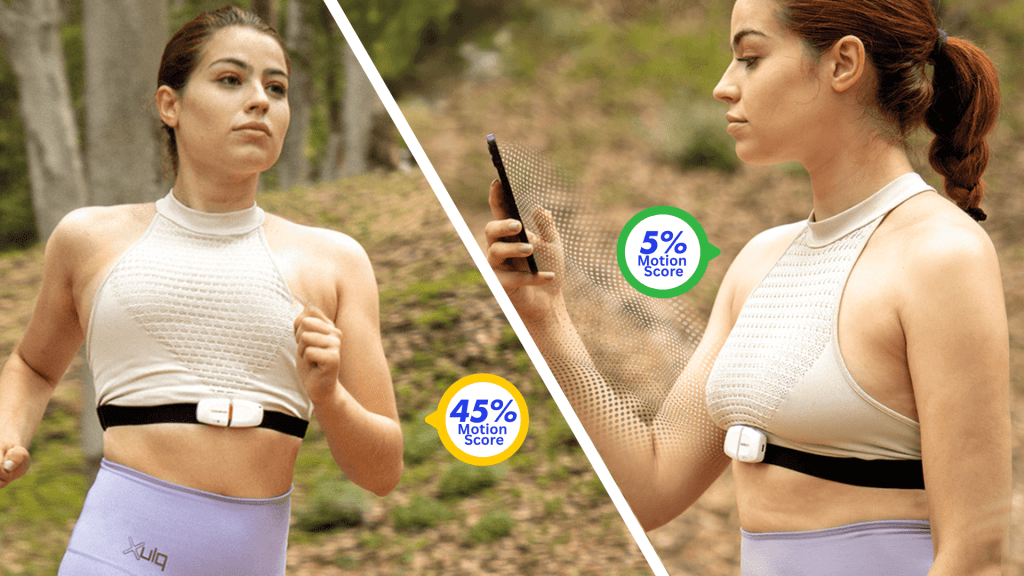
What is Motion Score?
Motion Score is a computed metric available on all Biosignals PRO Smart Sensors.
It combines data from the sensor’s accelerometer and gyroscope to quantify motion intensity during a recording.
The resulting value is expressed as a percentage between 0% and 100% and provides an intuitive representation of the amount of movement. A higher Motion Score indicates more intense movement. For example:
- 0–10%: Rest or small involuntary movements (talking, coughing).
- 10–20%: Walking, spinning, or sleep-related movements.
- 20–40%: Fast-paced walking or jumping.
- 40–60%: Jogging or running.
- 60–80%: Fast running.
- 80–100%: Explosive movements with rapid deceleration (e.g., tennis strokes, punching).

This makes Motion Score useful for:
- Detecting movement artifacts that may affect other sensor readings (e.g., EMG, ECG).
- Assessing motion levels in a simplified way without needing to process raw IMU data.
- Comparing activity between different sensors placed across the body (e.g., arm vs chest).
Why is this useful?
The Motion Score helps you detect activity patterns, identify motion artifacts, and monitor compliance during wearable sensor studies — all in real time. It adds a valuable contextual layer to biosignal analysis, enhancing both research and clinical applications.
For example, motion-sensitive sensors, such as optical Blood Oxygen Saturation (SpO2) sensors, fail to compute metrics like Heart Rate and SpO2 values when their waveforms are significantly distorted. The Motion Score helps you identify whether any signal distortion occurred due to motion.
Here is an example of 2 motion artifact impacted segments that distorted the SpO2 waveforms (PPGs) and resulted in a drop-out of SpO2 and Heart Rate metrics:

Which sensors support the Motion Score?
Motion Score is exclusively available on all Biosignals PRO Smart Sensors.
It is not available on biosignalsplux and BITalino sensors.
How do I activate the Motion Score?
The Motion Score (MtScr) can be de-/activated in your sensor settings and is listed as an additional signal channel of your sensor in Biosignals Studio.
Use Case Examples
Motion Score provides a reliable, real-time quantification of physical activity that can complement biosignal recordings in the following ways:
- Identify activity state: Biosignals change in periods of rest vs. motion, the Motion Score provides an additional layer of context.
- Identification of localized motion differences: Because each sensor has its own integrated motion sensors, Motion Score can reflect localized motion differences. For example, an arm-mounted EMG may detect fast accelerations while a chest-mounted ECG mainly records whole-body motion.
- Motion Artifact Identification: Raw signals can be distorted for various reasons, including physiological, pathological, external interference, or motion. Motion Score helps rule out and identify motion-related artifacts.
This makes Motion Score a versatile tool for both signal quality assessment and activity analysis across various research and application domains.
❤️ Motion Score + ECG
- Use case: Exercise stress test
- Interpretation: If a spike in ECG noise correlates with a Motion Score >30%, it’s likely motion-related (e.g., lead movement).
- Tip: Filter high-motion segments if you’re focused on resting ECG analysis.
💪 Motion Score + EMG
- Scenario: Muscle activation and fatigue analysis.
- Insight: Use Motion Score to distinguish local muscle contractions from whole-body motion or compensatory movements.
- Tip: High EMG amplitude + low Motion Score = likely isolated muscle activity.
🫁 Motion Score + SpO₂
- Scenario: Sleep studies or field performance tests.
- Insight: SpO₂ signal loss or drops during Motion Score >60% often indicate sensor instability rather than true desaturation.
- Tip: Flag high-motion periods when analyzing SpO₂ trends to avoid misinterpretation.
How is the Motion Score is computed?
1. Combining Accelerometer and Gyroscope Data
Motion Score is derived from Smart Sensors integrated 3-axis accelerometer and 3-axis gyroscope. For each sensor type, a vector magnitude is calculated to represent overall motion intensity:


These magnitudes reflect the total acceleration and angular velocity at each time point.
2. Sampling Rate and Decimation
The motion sensor data is sampled at 833 Hz (or higher). This high sampling rate captures rapid, transient motions that might otherwise be missed.
After the magnitudes are computed, the data can be decimated (downsampled) to 10 Hz. This process reduces noise, smooths the signal, and lowers computational load while maintaining relevant motion information.
3. Normalization
The magnitudes are normalized to a scale between 0 and 1, using the maximum and minimum values observed during calibration or experimentation:


This step ensures that different sensors or recordings can be compared consistently.
4. Weighted Combination
Both normalized components are combined with adjustable weighting factors α (Accelerometer) and β (Gyroscope):

where:
- α = 0.7 (70% weight to acceleration; default)
- β = 0.3 (30% weight to rotation; default)
- α + β = 1
These weights reflect that linear acceleration usually contributes more strongly to overall motion perception, while the gyroscope enhances sensitivity to rotational or turning movements.
5. Logarithmic Scaling
Human motion distribution is typically non-linear. Most daily activity involves small movements, while intense peaks are rare.
To make the Motion Score more perceptually uniform, a logarithmic transformation can be applied:

The γ (gamma) parameter adjusts the compression factor of the logarithmic scale:
- Default value: γ = 1
- Adjustable range: 0.001 to 65.535
This scaling increases sensitivity at low motion levels while compressing high-intensity peaks for a smoother, more intuitive range.
6. Low-Pass Filtering
After the Motion Score is computed, the resulting signal is passed through a low-pass filter to smooth out short-term fluctuations and provide a clearer representation of overall motion intensity.
This step reduces sharp variations caused by rapid direction changes or sensor noise.
