The respiBAN’s primary respiration sensor allows you to measure different types, rhythms, and intensities of respiratory patterns and apnea phases.
The following signals were recorded using a respiBAN for thoracic respiration monitoring from a healthy adult.
Download the recordings of all the samples plotted on this page here.
Respiration Signals
Normal Breathing
Respiration cycles in respiration signals are characterized by periodic peaks and valleys in the signal. Signal increases occur during the inspiration phase of the breathing cycle and peak at the maximum inspiration point. Signal decreases occur during the expiration phase of the breathing cycle and reach their minimum at full expiration.

During normal breathing, the frequency of the respiration cycles should be consistent with minor variations in length
Breathing Intensities (Normal vs. Deep Respiration)
Breathing intensities, such as normal vs. deep breathing, can be identified by changes in amplitudes of the respiration cycles.
The following plot shows the impact of normal breathing in breathing amplitudes against the increased amplitudes that occur during deep breathing.

Breathing Frequencies (Normal vs. Slow vs. Fast Respiration)
Respiration can be identified by changes in the intervals of the respiration cycles.
The following plot shows the impact of different breathing rhythms on the respiration signal, where the major change occurs in the frequency and duration of the respiration cycles.
Fast breathing shortens the interval of each respiration cycle and increases the cycle frequency. Slow breathing results in the contrary displaying longer intervals and reduced cycle frequency.

Note that different breathing frequencies can have other impacts on the signals that are of physiological nature. For instance, fast breathing results in generally lower signal amplitudes due to less air being inhaled and exhaled during the shorter respiration cycle. In this cases, a change in breathing amplitdude is expected in addition to the amplitude changes.
Apnea
Apnea is a temporary cessation of respiration. This can occur due to pathological reasons (e.g., sleep apnea, respiratory obstructions) or artificially induced by holding the breath.
Apnea in respiBAN sensor data is generally visible by the stagnation of the signal during the apnea phase. If the Apnea occurs at the end of an inspiration cycle, the signal remains at a (relatively) constant value near the respiration cycle’s peak value. If the apnea occurs at the end of the expiration phase, the value signals remains at a (relatively) constant value near the respiration cycle’s minimum value.

In ideal setups, respiBAN sensor data stagnates at the last value at which a any stretching or relaxation of the respiration belt occurred, i.e. at the value at which any respiratory motion stopped. However, when working with real-subjects, no ideal setup of breathing mechanics occur, as natural breathing mechanics show minor deviations from this expected behavior.
As seen in the Figure above, an Apnea phase occurred after a deep inspiration (see Post-Inspiration Apnea), yet the value does not plateau at the peak of the respiration signal. Instead, it shows a minor decline during the apnea phase. This is due to the subject’s natural breathing mechanics, as the artificially induced apnea (holding the breath) does not equal a complete block of the subject’s respiration mechanics. Due to the increased air pressure within the lungs, air partially escapes from the lungs, thus changes the volume of the thorax or abdomen which reuslts in the minor decline of the signal.
Apnea phases are generally more stable in Post-Expiration apnea as in Post-Inspiration apnea.
Motion Sensors
respiBAN comes with built-in triaxial Acceleromter and Gyroscope to record motion data along with your respiration data.
Accelerometer
The Accelerometer measures acceleration along the three axes (x, y, z). The amplitude of the signal correlates with the acceleration that occurs along each axis.
In the following signal, this ampltiude change is visualized in the following intervals:
- 0s to 10s: No acceleration / movement
- 10s to 20s: Moderate acceleration / movement
- 20s to 30s: Intensive acceleration / movement
- 30s to 40s: No acceleration / movement

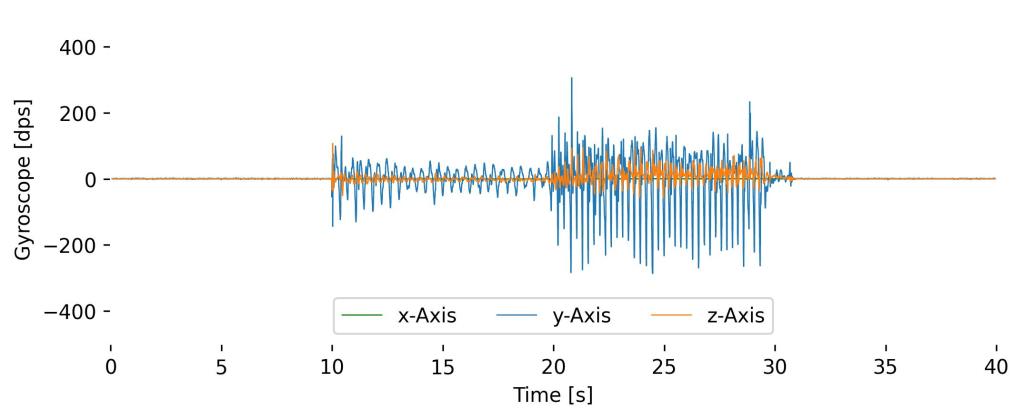
Gyroscope
The Gyroscope measures angular velocity, which is the rate at which an the respiBAN rotates around the axes (x, y, z). The amplitude of the signal correlates with the acceleration that occurs around each axis.
The following signals show the results of the Gyroscope when conducting the same motion pattern of the previous Accelerometer sample signal.